When people think about added sugar, they think about weight gain, diabetes or cavities, and not usually their joints, tendons, or bones. A growing body of research suggests that not only does the sugar you add to your coffee interfere, but also the added sugar hiding in sauces, cereals, and soft drinks.
Sugar and your joints
Osteoarthritis, the wear-and-tear form of arthritis, affected an estimated 27 million U.S. adults as of 2005. It is usually blamed on age, injury, and body weight. However, diet may play a role too. A 2024 study including 2,746 U.S. adults from the National Health and Nutrition Examination Survey found that those in the top quarter of added-sugar intake had approximately 40% higher odds of osteoarthritis than those in the bottom quarter. The link held across several groups, including women and people with a lower body mass index.
Animal research also points to possible reasons. At the Oklahoma Medical Research Foundation, mice fed more sucrose showed greater signs of joint inflammation, even though their weight and body fat matched mice on a lower-sugar diet. A separate study found that adding sucrose to a high-fat diet worsened cartilage erosion and bone changes in the knee.
Sugar and your tendons
Tendons and ligaments are built mostly from collagen. When blood sugar rises, glucose reacts with collagen to form advanced glycation end-products, or AGEs. These compounds act like extra cross-links between collagen fibers, making tissue stiffer and changing how it stretches and fails under load. In a lab study using high concentrations of a sugar by-product, rat tendons became stiffer and failed in a more abrupt, brittle way.
AGEs build up naturally with age, and diabetes speeds the process. People with diabetes have about 3.7 times higher odds of tendinopathy and are roughly five times more likely to have frozen shoulder. These studies measure diabetes rather than dietary sugar, but they show what chronically high blood sugar can do to connective tissue.
Sugar and your bones
Sugar-sweetened drinks may also be taking a toll on your bones. A 2021 systematic review of 26 studies covering more than 124,000 people found that, in adults, higher intake of sugar-sweetened beverages was associated with lower bone mineral density, with the clearest effect in women. Eighteen of the twenty additional studies the authors reviewed pointed the same way, and several linked heavy intake of these drinks to more fractures. Researchers think sugar may increase calcium loss in the urine, and sugary drinks often replace milk in the diet.
What it means for you
Most of this research is observational or preliminary. Nonetheless, cutting back costs little. Sugar-sweetened drinks are also strongly linked to weight gain and type 2 diabetes, and diabetes in particular takes a toll on tendons and joints.
A few simple steps can go a long way. Check labels for added sugars, swap soda for water or sparkling water, and watch for hidden added sugar in “healthy” foods like flavored yogurt, protein bars, plant-based milks, and smoothies.
A surgeon’s perspective
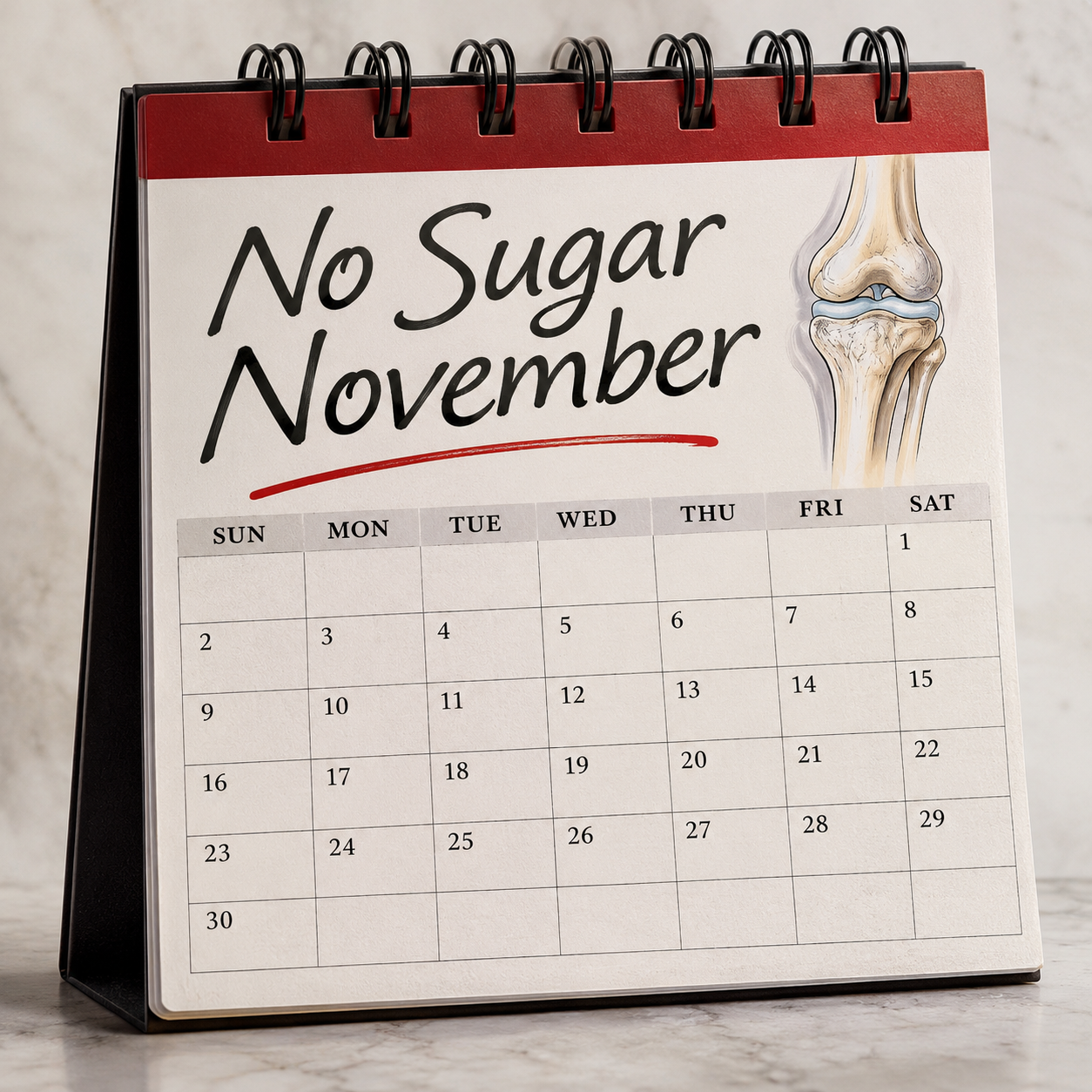
Orthopaedic surgeons see the long-term effects of metabolic disease through worn cartilage, stiff tendons, and slower recovery after surgery. H. John Cooper, MD, an orthopaedic surgeon with fifteen years in practice, explores this connection in No Added Sugar November: A Practical 30-Day Reset for Reducing Added Sugar. His book draws on published research and both his clinical and own personal experience cutting back on added sugar.
His approach targets added sugar only, not carbohydrates, fruit, dairy or the sugar that occurs naturally in whole foods. It also covers where added sugar tends to hide and how to read a Nutrition Facts label quickly, which is a practical starting point for anyone who wants to test how a month of less sugar affects how they feel.
November has just begun, so today is a great day to start. If you want to try No Added Sugar November, you can get the book here: https://www.amazon.com/No-Added-Sugar-November-Practical/dp/B0HLP2NC69/
References:
1. Lawrence RC, Felson DT, Helmick CG, et al. Estimates of the prevalence of arthritis and other rheumatic conditions in the United States. Part II. Arthritis Rheum. 2008;58(1):26-35. doi:10.1002/art.23176
2. Liao X, Chen X, Zhou Y, Xing L, Shi Y, Huang G. Added sugars and risk of osteoarthritis in adults: a case-control study based on National Health and Nutrition Examination Survey 2007-2018. PLoS One. 2024;19(11):e0313754. doi:10.1371/journal.pone.0313754
3. Donovan EL, Lopes EBP, Batushansky A, Kinter M, Griffin TM. Independent effects of dietary fat and sucrose content on chondrocyte metabolism and osteoarthritis pathology in mice. Dis Model Mech. 2018;11(9):dmm034827. doi:10.1242/dmm.034827
4. Min Y, Ahn D, Truong TMT, et al. Excessive sucrose exacerbates high fat diet-induced hepatic inflammation and fibrosis promoting osteoarthritis in mice model. J Nutr Biochem. 2023;112:109223. doi:10.1016/j.jnutbio.2022.109223
5. Fessel G, Li Y, Diederich V, et al. Advanced glycation end-products reduce collagen molecular sliding to affect collagen fibril damage mechanisms but not stiffness. PLoS One. 2014;9(11):e110948. doi:10.1371/journal.pone.0110948
6. Ranger TA, Wong AMY, Cook JL, Gaida JE. Is there an association between tendinopathy and diabetes mellitus? A systematic review with meta-analysis. Br J Sports Med. 2016;50(16):982-989. doi:10.1136/bjsports-2015-094735
7. Zreik NH, Malik RA, Charalambous CP. Adhesive capsulitis of the shoulder and diabetes: a meta-analysis of prevalence. Muscles Ligaments Tendons J. 2016;6(1):26-34. doi:10.11138/mltj/2016.6.1.026
8. Ahn H, Park YK. Sugar-sweetened beverage consumption and bone health: a systematic review and meta-analysis. Nutr J. 2021;20(1):41. doi:10.1186/s12937-021-00698-1
About the Author:
Catelyn Woelfle is a 2nd year medical student at Rutgers Robert Wood Johnson Medical School.