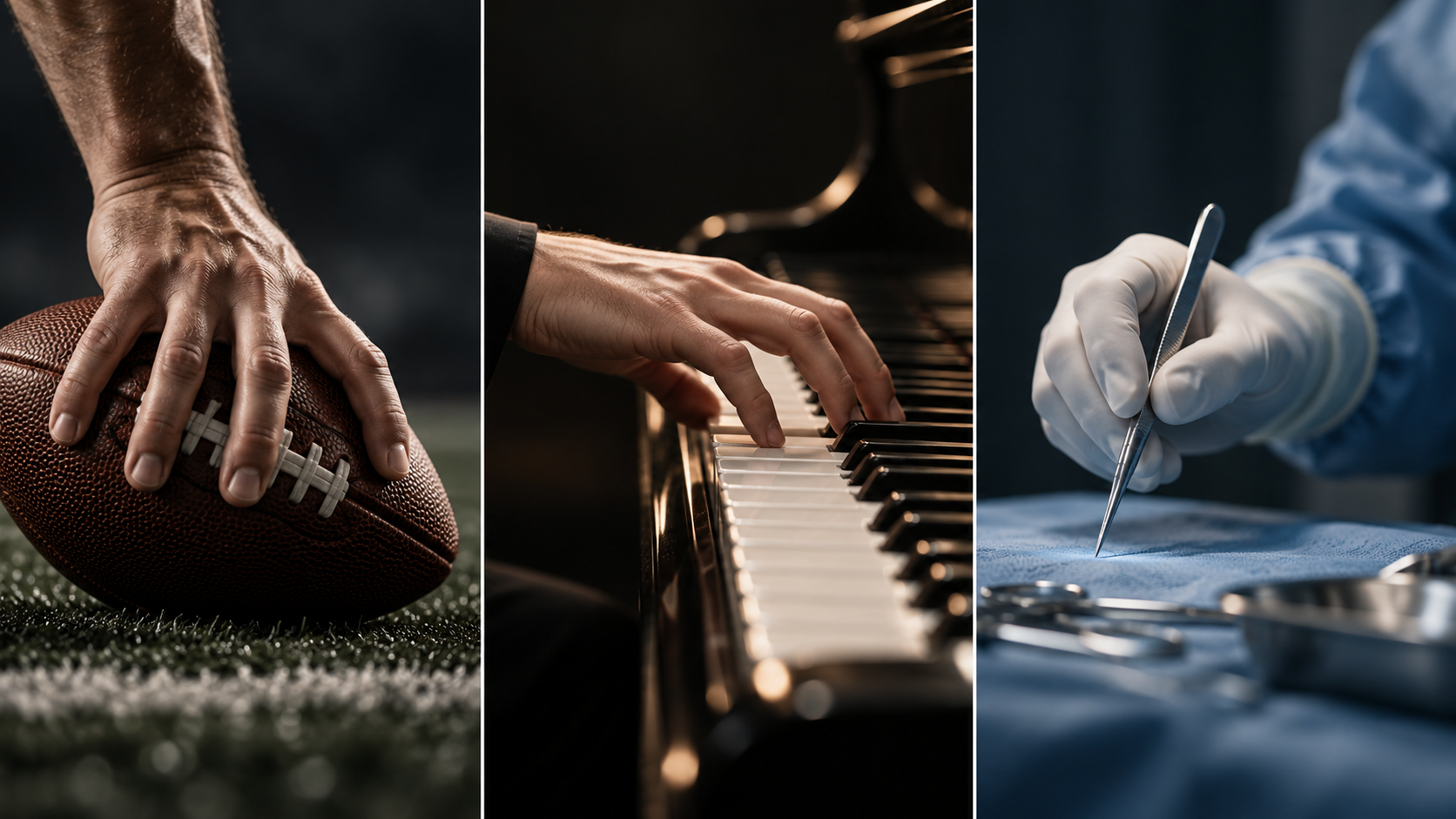
We rarely notice how much we rely on our hands until something goes wrong, and for athletes, musicians, and surgeons, even small injuries can have big consequences.
Every football season comes with injuries, and this fall, two of the more notable ones both involved the thumb. In early September, Dallas Cowboys guard Tyler Smith had surgery to repair a torn ligament in his left thumb after trying to play through it during training camp. A few weeks later, Tampa Bay Buccaneers quarterback Baker Mayfield dislocated his thumb on his throwing hand. Although his MRI didn’t show any ligament or tendon damage, he’s still expected to be sidelined for up to six weeks. Smith uses his hands mostly for grip strength when blocking, while Mayfield needs precise control of the ball when he throws. While athlete injuries are almost always in the news, we often forget how similar injuries affect musicians and surgeons as well.
What is Fine Motor Control?
Fingers are moved by two groups of muscles. The extrinsic muscles originate in the forearm and send long tendons into the hand, providing most of the strength for gripping and pulling, and the intrinsic muscles lie within the hand itself. The thenar muscles at the base of the thumb allow it to rotate to meet the other fingers, and the interossei between the finger bones make smaller adjustments to each digit. Intrinsic muscles play a major role in fine manipulation, tuned for grading small amounts of force. Nerves in this region supply both motor and sensory innervation. Fine motor control therefore depends on fingers that move independently, on precise force, and on good sensory feedback. Different jobs rely on different parts of this system more heavily.
On the Field
Athletes need fine motor control that holds up under contact and speed. A lineman mostly needs grip strength and a stable thumb. A quarterback needs more precise force control, since the ball leaves his fingertips last, and small changes in pressure affect how it spins. Currently, surgeons who treat athletes account for these differences in players’ positions. In a study of collegiate football players treated with the same thumb ulnar collateral ligament suture-anchor repair, skill-position players returned to play at about 7 weeks postoperatively compared with about 4 weeks for non-skill-position players, even though final level of play and outcome scores were equivalent. The authors concluded that management can be safely tailored to the demands of the player’s position.
Precision and Control in Music
For musicians, finger independence and speed are especially important. Pianists have to move each finger separately and quickly. Violinists have to place their fingers within millimeters of the right spot to play in tune, while the bow hand shapes the sound largely through pressure. Part of this skill reflects changes in the brain. For example, studies of string players have found that the cortical area representing the fingers of the left hand is enlarged relative to non-musicians, particularly in those who began playing at a young age. This kind of adaptation musicians have can also go wrong. A small proportion of professional musicians, which was estimated at roughly 0.2–0.5% develop task-specific focal dystonia, losing control of movements they have practiced for years. In focal dystonia, the fingers may curl or freeze, usually only while playing. Here, involuntary co-contraction of agonist and antagonist muscles degrades the refined, individuated movements the performance requires. Because the hand typically looks normal on exams and imaging, surgery does not help. It is important for orthopaedic surgeons to recognize this pattern so the musician is referred to the right specialist instead of receiving unnecessary injections or procedures.
The Surgeon’s Own Hands
Orthopaedic surgeons use a wide range of hand skills, sometimes in a single case. During a fracture repair, a surgeon may hammer in a nail and then need to feel the moment a drill passes through the far cortex so it does not plunge into soft tissue. In arthroscopy, surgeons manipulate instruments through small incisions while watching a screen. All of this takes a physical toll. A systematic review and meta-analysis found that roughly 35%–60% of at-risk proceduralists report significant pain when operating, and that 12% of those with a work-related musculoskeletal disorder required a leave of absence, practice modification, or early retirement.
Clinical Pearl
When examining a hand injury, assess components of fine motor control separately, such as stability, finger independence, force grading, and sensory feedback. This is important rather than reducing the exam to a single grip-strength or range-of-motion number. Then set rehabilitation milestones and return-to-activity criteria accordingly.
Why it Matters
Athletes, musicians, and surgeons are clear examples, but most patients depend on their hands for something important to them, such as typing at work, cooking, or hobbies like crocheting or painting. If you have a hand injury, it helps to tell your care team exactly what matters to you.
References:
Sobinov AR, Bensmaia SJ. The neural mechanisms of manual dexterity. Nat Rev Neurosci. 2021;22(12):741-757. doi:10.1038/s41583-021-00528-7
Werner BC, Hadeed MM, Lyons ML, Gluck JS, Diduch DR, Chhabra AB. Return to football and long-term clinical outcomes after thumb ulnar collateral ligament suture anchor repair in collegiate athletes. J Hand Surg Am. 2014;39(10):1992-1998. doi:10.1016/j.jhsa.2014.06.132
Elbert T, Pantev C, Wienbruch C, Rockstroh B, Taub E. Increased cortical representation of the fingers of the left hand in string players. Science. 1995;270(5234):305-307. doi:10.1126/science.270.5234.305
Charness ME. Brain surgery for musician’s dystonia. Ann Neurol. 2013;74(5):627-629. doi:10.1016/j.clineuro.2020.105911
Epstein S, Sparer EH, Tran BN, et al. Prevalence of Work-Related Musculoskeletal Disorders Among Surgeons and Interventionalists: A Systematic Review and Meta-analysis. JAMA Surg. 2018;153(2):e174947. doi:10.1001/jamasurg.2017.4947
About the Author
Srinidhi Gopalan is a first-year medical student at Rutgers Robert Wood Johnson Medical School.