New insurance rules may not leave orthopaedic schedules empty. They may change who provides care, who pays for it, and when patients reach the appropriate clinician.
A recent New York Times editorial raised concerns about federal changes that are expected to reduce health insurance coverage. The enhanced Affordable Care Act subsidies expired at the end of 2025, increasing premiums for many people who buy insurance on their own. A separate federal law passed in 2025 adds new Medicaid eligibility and reporting requirements. Beginning no later than January 1, 2027, many working-age adults will need to document employment or another approved activity to remain eligible.
The Congressional Budget Office expects the number of uninsured Americans to rise as these changes take effect. But what that means for orthopaedics is less straightforward.
The effects will differ by practice
Many private orthopaedic practices do not accept Medicaid. For those practices, the new rules may have little immediate effect. Most orthopaedists already have full schedules and waits of several weeks. If the wait for an appointment falls from three weeks to one week, the surgeon may still remain fully booked.
That is not true everywhere. Some private orthopaedists and medical groups participate in Medicaid through managed-care plans such as Horizon NJ Health. Many provide timely, high-quality care. These practices could see fewer patients if people lose coverage, even though the need for musculoskeletal care has not changed.
We should not assume that every Medicaid patient is treated in a hospital clinic staffed by residents or must wait months for an appointment. A 2025 national study found that 63 percent of the orthopaedic surgeons included in its final analysis accepted Medicaid. When Medicaid was accepted, the average wait was approximately 25 business days, compared with 20 days for private insurance. Access was clearly more limited, but it was not absent.
The care may continue, but the cost moves
Losing insurance does not necessarily mean that a patient will receive no care. Patients with fractures, infections, and other urgent problems will still enter through emergency departments. Orthopaedists who take call, including physicians in private practice, may be required by their hospital responsibilities to evaluate these patients and provide follow-up even when they are uninsured.
New Jersey’s Charity Care program provides free or reduced-cost hospital care for qualifying uninsured and underinsured patients. That support matters, but it does not make the cost disappear. If more patients lose Medicaid or marketplace coverage and enter the Charity Care system, hospitals may submit more uncompensated-care claims and the state may need to reconsider how the program is funded. In that sense, some of the expected savings from reducing insurance coverage may simply reappear elsewhere in the health care system.
The effect may therefore be less visible than an empty appointment slot. The same patient may see the same physician, but someone still has to pay for the imaging, staff, facility, and follow-up care.
Patients will take different routes
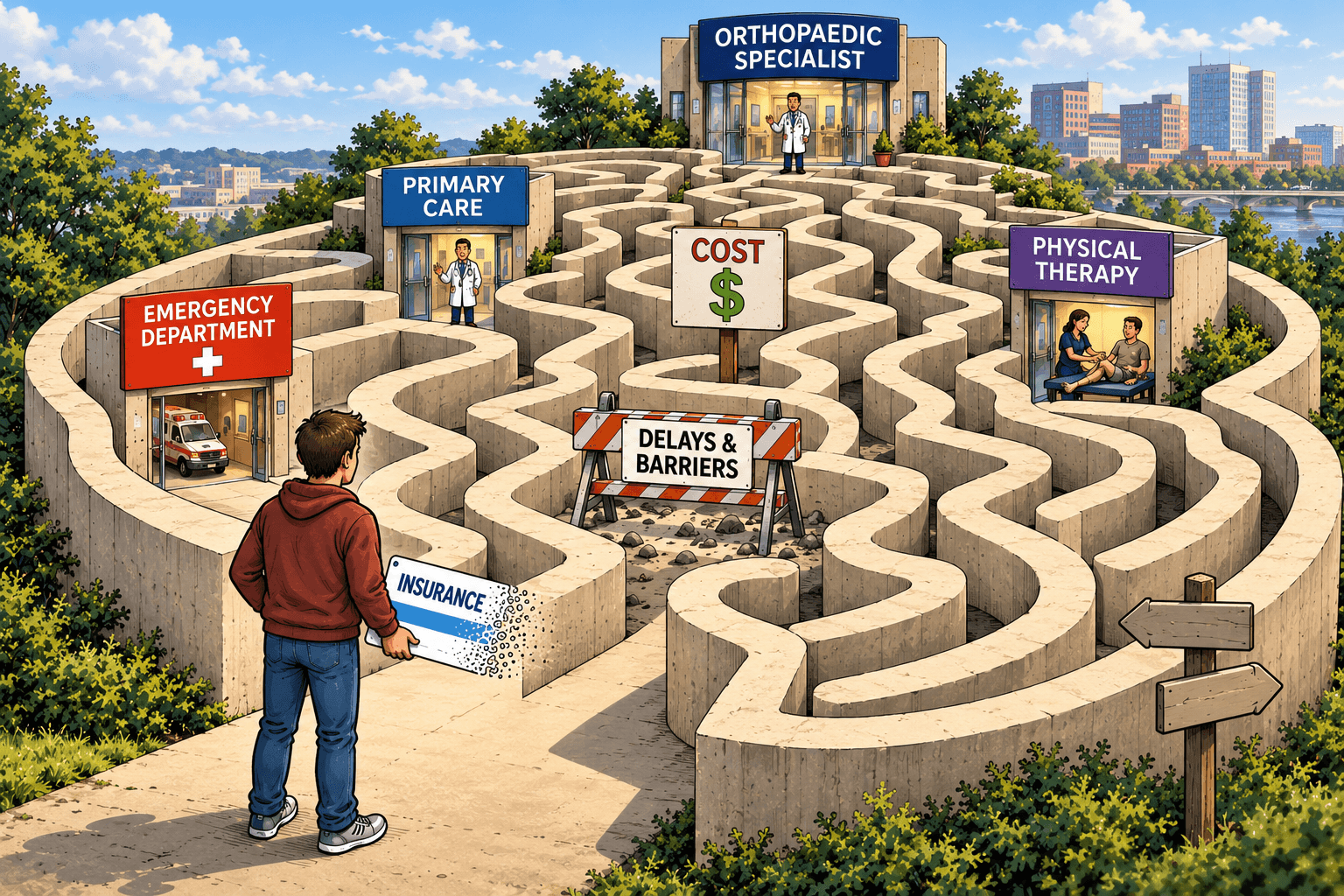
There is far more musculoskeletal disease than orthopaedic surgeons can treat directly. Patients who cannot obtain or afford an orthopaedic appointment may seek care through family physicians, urgent care centers, physical therapists, chiropractors, emergency departments, or hospital clinics.
Many common conditions can be treated well in these settings. Not every patient with back pain, arthritis, or a stable fracture needs to begin with an orthopaedic surgeon. The concern is that losing coverage may make the route to the appropriate level of care less direct.
Some patients will receive effective nonsurgical treatment. Others may move through several settings before reaching a specialist. Some may delay imaging, therapy, medications, or follow-up because of cost. The problem is not simply whether they eventually see someone. It is whether they receive the right care at the right time.
The mix of patients coming through emergency departments may also change. Orthopaedists taking call may see more patients who previously would have had Medicaid or marketplace coverage but are now uninsured. The obligation to provide care remains, while payment for that care becomes less certain.
Before Medicare and Medicaid were created in 1965, uninsured patients relied more heavily on public hospitals, charity care, family support, direct payment, or simply went without treatment. Care still occurred, but access was inconsistent and more of the financial burden fell on patients, physicians, hospitals, and local communities.
More care is not always better care
There is also a legitimate counterargument. Insurance can make it easier to obtain treatment that provides little additional benefit. Orthopaedic surgeons should not assume that every operation made possible by insurance is necessary.
Some fractures, ligament injuries, and degenerative conditions do well with immobilization, therapy, observation, or time. A radiographic abnormality does not always produce symptoms, and a technically correct operation is not automatically better than thoughtful nonoperative care. Orthopaedics must acknowledge that financial incentives and patient expectations can contribute to overtreatment.
But reducing insurance coverage is a poor way to control unnecessary care. It does not reliably distinguish between a procedure that can be avoided and treatment that prevents disability. Evidence-based indications, shared decision-making, and honest discussion of nonoperative options are better tools.
What should we watch?
The first sign of these policy changes may not be open appointment slots. It may be fewer Medicaid or marketplace patients in participating practices, more self-pay cancellations, greater uncompensated care at hospitals, and more patients arriving after several stops elsewhere in the health care system.
The effects will vary. Some private practices may notice almost nothing. Medicaid-participating orthopaedists may lose established patients. Hospitals may continue providing care but receive less payment for it. Some patients will be treated successfully outside orthopaedics, while others may reach specialist care later or not at all.
The central question is not whether orthopaedic surgeons will remain busy. They probably will. The question is whether patients will continue to receive timely, appropriate musculoskeletal care and whether the institutions providing that care can continue to support it.
References
- The Editorial Board. Republicans Are Trying to Hide These Health Care Cuts. The New York Times. August 15, 2026. Accessed September 10, 2026. nytimes.com
- Centers for Medicare & Medicaid Services. Community Engagement. Medicaid.gov. Accessed September 10, 2026. medicaid.gov
- Congressional Budget Office. Federal Subsidies for Health Insurance, 2026 to 2036. July 23, 2026. Accessed September 10, 2026. cbo.gov
- Felan NA, Garcia-Creighton E, Hirpara A, et al. Navigating the Orthopaedic Maze as a New Patient: A National Mystery Caller Study on Medicaid Coverage and Access to Specialized Surgeons. J Am Acad Orthop Surg. 2025;33(3):e181-e190. doi:10.5435/JAAOS-D-24-00668
- New Jersey Department of Health. New Jersey Charity Care: Hospital Care Payment Assistance Program. Accessed September 10, 2026. nj.gov
Brian M. Katt, MD
Faculty, Rutgers Robert Wood Johnson Medical School